24 August, 2026 0 comments Leave a comment
Table of Contents
- How to Choose the Right Cheer Bow Styles for All Star Teams
- Top Cheer Bow Styles for All Star Competition Teams
- Custom Competition Cheer Bows: Design Options That Win
- Rhinestone Cheer Bow Designs That Stand Out on the Mat
- Cheer Bow Durability Tips: Making Your Bows Last the Season
- DIY vs. Professional Manufacturing for All Star Bows
- Conclusion
Last Updated: August 24, 2026
How to Choose the Right Cheer Bow Styles for All Star Teams
A bow that slips, droops, or loses its shape mid-routine doesn't just look unprofessional, it distracts athletes during stunts and tumbling where focus is critical. The best cheer bow styles balance visual impact with secure, reliable wear: the right size for each athlete's hair volume, an age-appropriate silhouette for the team's competitive level, and construction materials that hold up through multiple competitions without peeling, fraying, or losing shape.
Bow Size and Hair Volume Considerations
Bow size should match both the athlete's hair volume and the scale of the uniform. A large, layered bow on fine hair will shift and droop by the second tumbling pass. A small bow on thick, high-volume hair will look undersized under competition lighting.
Athletes with thicker hair generally wear 6-inch to 8-inch bows comfortably, while athletes with finer hair do better with 4-inch to 6-inch styles (the American Academy of Dermatology). A quality bow should grip the ponytail firmly without requiring re-tying between events. Tail length also matters, longer tails add movement but can interfere during back walkovers or basket tosses if not cut and sealed properly.
Age-Appropriate Style Guide for All Star Levels
Youth athletes (ages 5-10) look best in smaller, simpler bows with bright, solid colors and minimal embellishment. Junior athletes (ages 11-14) can carry medium to large bows with glitter HTV accents or modest rhinestone placement. Senior and open-level athletes are where oversized, heavily embellished competition bows shine.
According to USA Cheer's competitive guidelines, all star divisions follow structured age and skill criteria that influence appropriate uniform presentation. Matching bow style to division expectations is part of presenting a cohesive, competition-ready team image.
Top Cheer Bow Styles for All Star Competition Teams
The five styles below represent the most widely used and competition-proven options in all star cheerleading today.
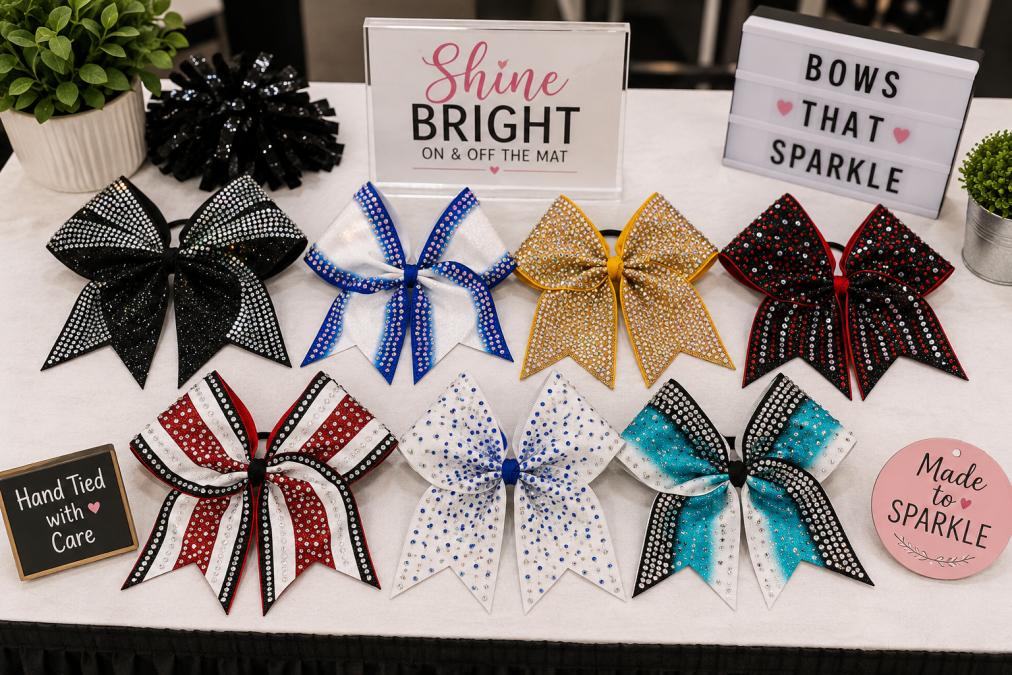
Close-up of several colorful all star cheer bows laid out on a flat surface, showing different styles including glitter, rhinestone, and sublimated fabric bows with vibrant team colors
Quick Picks:
- Best for tradition and versatility: Classic grosgrain ribbon bows
- Best for maximum sparkle: Glitter HTV bows
- Best for full custom branding: Sublimated fabric bows
- Best for structural hold: Stiffened fabric bows with heat transfer vinyl
- Best for stage presence: Layered and oversized competition bows
1. Classic Grosgrain Ribbon Bows
Grosgrain ribbon bows have earned their foundation status in cheer. The tightly woven texture gives these bows a clean, structured look that holds its shape through tumbling and stunting. They're available in virtually every team color combination, making color coordination straightforward.
The quality of the center knot construction separates a bow that lasts a season from one that unravels by week three. A properly finished center knot with reinforced stitching is non-negotiable for competition use. These bows work well at every competitive level and represent a reliable, cost-effective option for bulk ordering.
2. Glitter HTV Bows
Glitter heat transfer vinyl bows are the current standard for teams wanting high visual impact without the weight and fragility of rhinestone designs. When applied correctly with proper heat and pressure, glitter HTV creates a surface that resists peeling through repeated wear.
Professional manufacturing with calibrated heat press equipment produces a bond that outlasts DIY iron-on methods significantly. The sparkle density reads well under competition stage lighting, making these bows a strong choice for senior and junior all star levels.
3. Sublimated Fabric Bows
Sublimated fabric bows offer full custom competition design. Sublimation printing bonds dye directly into the fabric at a molecular level, producing vibrant patterns, mascot integration, and gradient color effects that cannot be achieved with ribbon or HTV alone.
A team can incorporate exact color codes, mascot artwork, and text into the bow pattern. Because the dye is embedded in the fabric rather than sitting on top of it, sublimated bows don't crack, peel, or fade like surface-applied designs. They require a minimum order to be cost-effective, since each design requires a custom print run.
4. Stiffened Fabric Bows with Heat Transfer Vinyl
Stiffened fabric bows use interfacing or backing material to maintain shape, then heat transfer vinyl is applied for team colors and graphics. The structural advantage is significant, stiffened bows maintain their bow shape through the entire competition day without wilting, even in warm, humid gym environments.
This style is particularly popular for programs competing in multiple events across a weekend, since the bow holds its structure without requiring re-shaping between rounds.
5. Layered and Oversized Competition Bows
Oversized layered bows stack multiple bow layers, often combining grosgrain, stiffened fabric, and accent ribbon, to create significant visual depth and stage presence. Under competition lighting, the dimensional layering catches light differently than a single-layer bow, producing a more dynamic visual effect.
These bows are best suited to senior and open-level athletes with sufficient hair volume to support the weight and width. The construction complexity of layered bows means professional manufacturing is almost always the better path.
Custom Competition Cheer Bows: Design Options That Win
Custom competition cheer bows are part of a team's competitive identity. Judges notice cohesion. A squad where every athlete's bow matches precisely in color, size, and finish presents as more polished than one with slight variations.
Matching Team Colors, Mascots, and Branding
Color coordination starts with exact color matching, not approximate matching. Provide your manufacturer with specific color references, Pantone codes, fabric swatches, or hex values for sublimated designs.
Mascot integration works best through sublimated fabric bows. For programs wanting mascot elements without full sublimation, rhinestone placement can outline logos or initials effectively. The mascot element should be recognizable from the judging panel's distance.
As documented in USASF's uniform and appearance guidelines, all star teams are expected to present a uniform appearance across the squad. Mismatched bows can affect the overall presentation score.
Budget Optimization for Team Managers and Coaches
Ordering Approach |
Best For |
Key Consideration |
|---|---|---|
Bulk standard styles |
Programs with 20+ athletes, tight budget |
Lower per-unit cost, limited customization |
Custom sublimated, full run |
Established programs, consistent squad size |
Higher per-unit cost offset by branding value |
Mixed approach |
Mid-size programs |
Standard base bow with custom HTV name/number |
Fundraising bow program |
Booster clubs and PTOs |
Custom logo bows sold to supporters offset team cost |
The most underused budget strategy is the fundraising bow program. Custom logo bows sold through booster clubs and parent organizations generate revenue that offsets the cost of competition bows for the squad.
Rhinestone Cheer Bow Designs That Stand Out on the Mat
Rhinestone cheer bow designs are the highest-impact option for senior and open-level all star competition. When executed correctly, rhinestone accents catch competition lighting in a way no other embellishment replicates.
A cheerleader in full uniform with a large rhinestone cheer bow in her high ponytail, photographed mid-performance under bright competition lighting that catches the sparkle of the rhinestone accents
Sparkle Density and Placement for Maximum Stage Impact
Sparkle density refers to how many rhinestones are applied per square inch and how they're distributed. Rhinestones clustered at the center knot and bow tips catch the most light during performance, while uniform distribution can look flat under stage lighting.
The most effective designs use strategic placement: heavier concentration at focal points with lighter fill across the bow body. For senior-level competition, rhinestone accents should be visible from 20 to 40 feet away. Stones smaller than SS10 (approximately 2.8mm) often don't read at that distance.
Competition-Ready Standards for Rhinestone Application
The technical standard separating competition-ready rhinestone bows from decorative ones is adhesive quality and application method. Rhinestones applied with heat-set adhesive backing, using a proper rhinestone applicator at the correct temperature, bond significantly more durably than cold-glue methods.
Rhinestones that fall off mid-performance create a slip hazard on the mat. Professional manufacturers with dedicated rhinestone application equipment produce bonds that hold through the entire competitive season without requiring touch-ups.
Cheer Bow Durability Tips: Making Your Bows Last the Season
Most bow failures are predictable and preventable.
Performance-Based Durability: What to Look For Before You Buy
Ask manufacturers about:
- Adhesive bond strength: Whether rhinestones and HTV are tested after application before shipping
- Wash resistance: Competition bows should maintain appearance through at least 10 hand-washes
- Structural integrity under tension: The center knot and elastic attachment should withstand repeated tying and removal
- Color fastness: Sublimated and HTV colors should not fade or bleed after exposure to sweat and competition floor conditions
Manufacturers who reference industry testing standards signal that their production process has been evaluated against objective benchmarks.
Storage and Maintenance Between Competitions
Store bows flat or hanging, never compressed. Keep bows away from direct heat sources between competitions. Spot-clean with a damp cloth rather than submerging in water. For rhinestone bows, inspect stone adhesion after each competition and address any loose stones before the next event.
DIY vs. Professional Manufacturing for All Star Bows
DIY bows make sense for practice bows, spirit bows for non-competitive events, or fundraising items. For competition bows, professional manufacturers offer adhesive consistency, heat press equipment, and quality control that consumer-grade tools cannot replicate.
The most common DIY failure points, rhinestones that detach, HTV that peels at edges, center knots that loosen, are equipment and technique issues. Booster club volunteers working with household irons and craft-store adhesives aren't doing anything wrong; they're working with tools not engineered for the bond strength competition wear demands.
A hybrid approach works well: purchase professional competition bows for the main squad and use DIY methods for spirit accessories and fundraising items where durability standards are lower. Once you factor in material costs, equipment, and time investment, bulk ordering from a professional manufacturer is often competitive with DIY production at scale.
For coaches evaluating this decision: if the bow will be worn in USASF-sanctioned competition, professional manufacturing is the lower-risk path.
Style |
Best For |
Key Strength |
Main Limitation |
|---|---|---|---|
Classic grosgrain ribbon |
All levels, bulk orders |
Versatile, durable, color variety |
Less visual impact than embellished styles |
Glitter HTV |
Junior and senior all star |
High sparkle, peeling-resistant when pressed correctly |
Requires commercial heat press for durability |
Sublimated fabric |
Full custom branding |
Vibrant patterns, mascot integration, fade-resistant |
Minimum order quantities required |
Stiffened fabric with HTV |
Multi-day competitions |
Holds shape all day, clean graphic look |
Less flexible for hair volume variation |
Layered oversized |
Senior and open level |
Maximum stage presence, dimensional effect |
Requires higher hair volume, heavier weight |
Rhinestone accents |
Senior competition |
Highest visual impact under stage lighting |
Most vulnerable to adhesive failure if DIY |
Choosing the right cheer bow style for your all star team comes down to matching construction quality to competition demands. The Ultimate Bow offers custom competition cheer bows across all the styles covered in this guide, sublimated, glitter HTV, rhinestone, and layered designs, with team packages, bulk ordering, and fundraising bow programs designed for gyms and coaches managing real budgets. Get started with The Ultimate Bow and put your squad on the mat with bows that hold up through every routine.
Frequently Asked Questions
What are the most durable materials for competition cheer bows?
Stiffened fabric, grosgrain ribbon, and sublimated polyester are the top choices for competition cheer bows. Stiffened fabric holds its bow shape through tumbling and stunting without wilting. Sublimated fabric resists fading over a full season. For embellishments, heat-pressed rhinestones and glitter HTV outlast adhesive-only applications. When evaluating cheer bow durability, check that seams are reinforced and that the elastic ponytail holder is securely anchored, not just knotted.
What is the difference between practice bows and competition bows?
Practice bows are typically simpler grosgrain or basic fabric styles without heavy embellishment. Competition bows are built to meet event standards: larger bow shapes, stiffer construction, vibrant patterns, rhinestone accents, or glitter HTV that catches stage lighting. Custom competition cheer bows also incorporate team colors, mascot integration, and consistent center knots so every athlete looks uniform. The construction quality is noticeably higher because competition bows need to survive full routines without shifting or losing embellishments.
How do you choose the right size cheer bow for all-star athletes?
Bow size should match the athlete's age level and hair volume. Youth and mini all-star athletes typically wear bows in the 4- to 5-inch range, while junior and senior elite athletes go up to 6 to 8 inches for maximum visibility from the judges' table. A bow that is too large for fine hair will droop; a bow that is too small gets lost in thick hair. Always pair the bow size to the ponytail holder tension so the bow stays centered and secure through stunts and tumbling.
How do you keep cheer bows looking new throughout the season?
Store bows flat or hanging, never crushed in a bag. Keep rhinestone cheer bow designs away from moisture, which can loosen adhesive over time. Spot-clean fabric with a damp cloth rather than machine washing. For glitter HTV bows, avoid folding along the vinyl because repeated creasing cracks the finish. A quick steam from a handheld steamer can restore the bow shape between competitions. Following these cheer bow durability tips consistently extends the life of even heavily embellished styles.
How can custom bows improve team branding and unity?
Custom competition cheer bows signal to judges and audiences that a program is organized and serious. When every athlete wears the same bow with consistent color coordination, mascot integration, and tail length, it reinforces team identity visually from across the floor. Beyond aesthetics, matching bows build athlete confidence. Coaches often report that athletes perform with more cohesion when their uniforms, including hair accessories, are fully coordinated. Custom bows also make strong fundraising items for booster clubs selling team spirit gear.
This article was written using GrandRanker


Comments